
Spring Forward: Daylight Savings Time with Kids

Of the two time changes, Spring Forward is the lesser of the two evils (and yes, I do view them as evils—maybe you don’t, and may God bless you for your patience and chill). But if you suspect your routine-loving child—or, let’s face it, your routine-loving self—is going to struggle with this transition, there are options to help you prepare your family OR get back on track if things fall apart afterwards.
Here are several different ways to help your child adjust to Daylight Savings Time.
How can we prepare to “spring forward”?
In the fall in the United States, we will “spring forward” by turning our clocks ahead one hour. At 2am on a Sunday morning, clocks will reset to 3am. So when it reads 6am on the clock, it will feel like 5am; when it reads 7am, it will feel like 6am, etc.
For children who typically wake before or around the time their parents get them up, the time change may not feel like that big of a deal, or they might just be a bit more tired that morning since their bodies feel like they woke earlier. When it’s time to head to bed in the evening, their bodies may still feel like it’s an hour earlier, which might cause some bedtime struggles.
As I mentioned, for most children, this time change is easier on them than “falling back,” and it just takes a few days to adjust. But if you’d like to consider options, here they are!
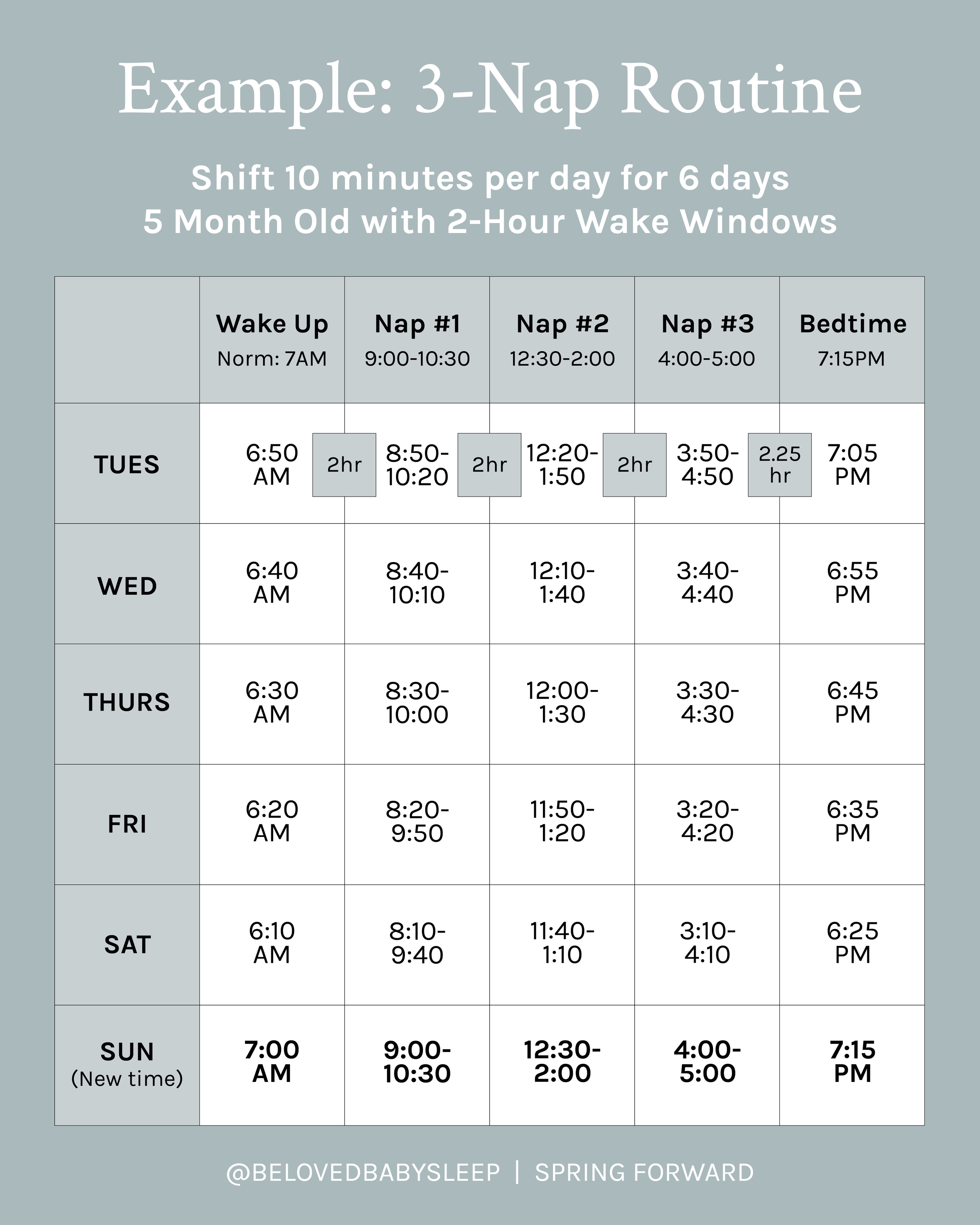
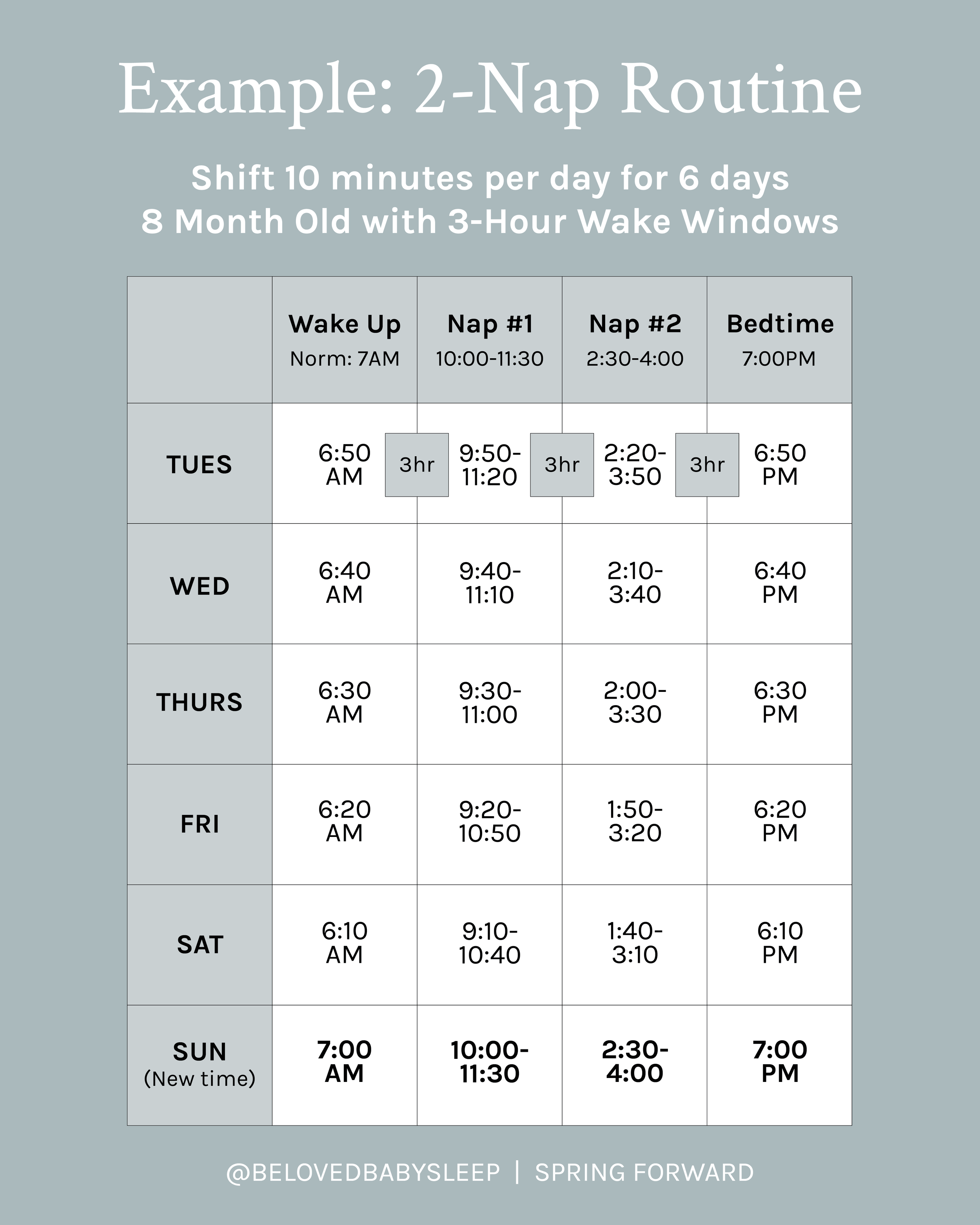
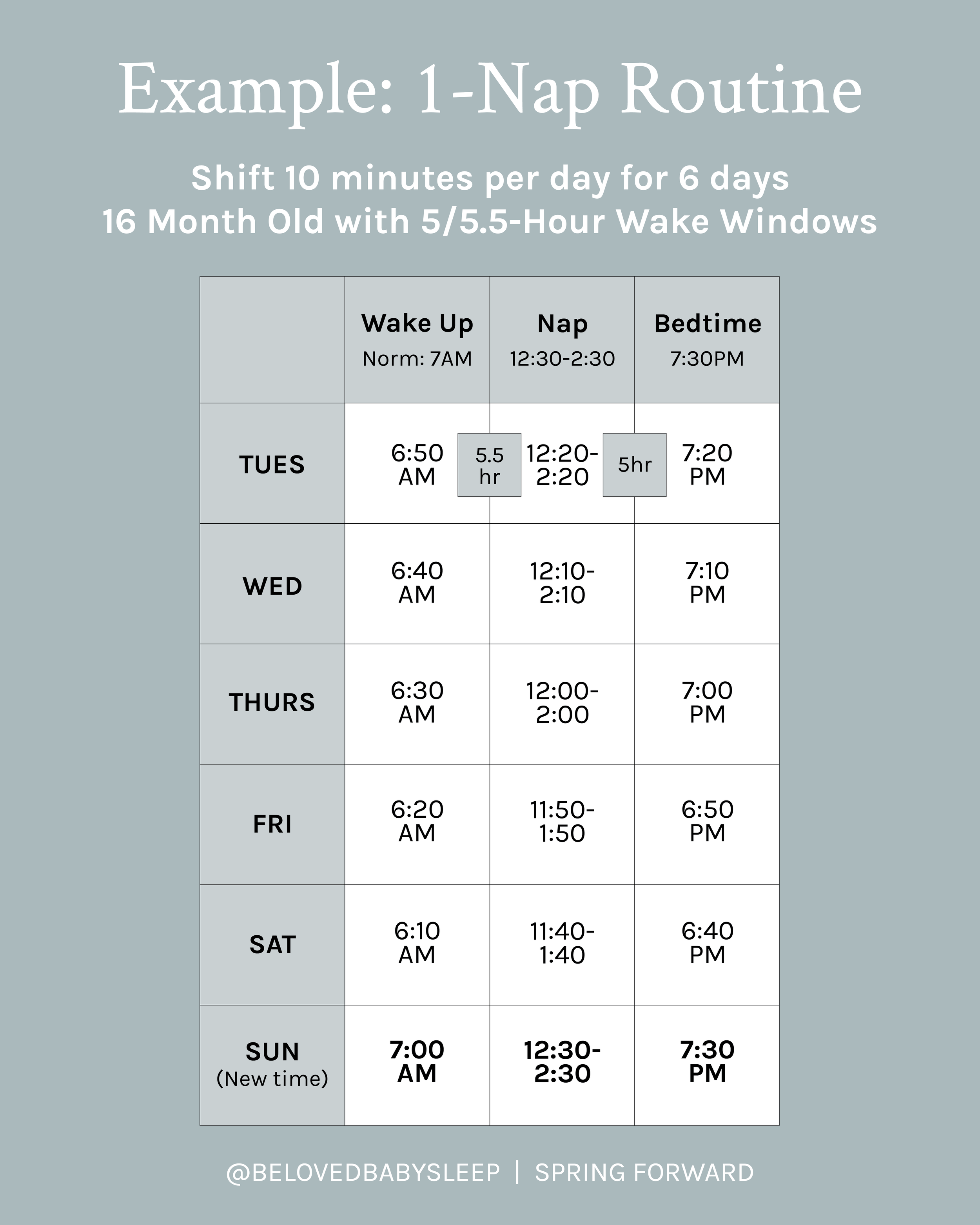
Shift your routine 10 minutes per day starting 6 days prior to the time change.
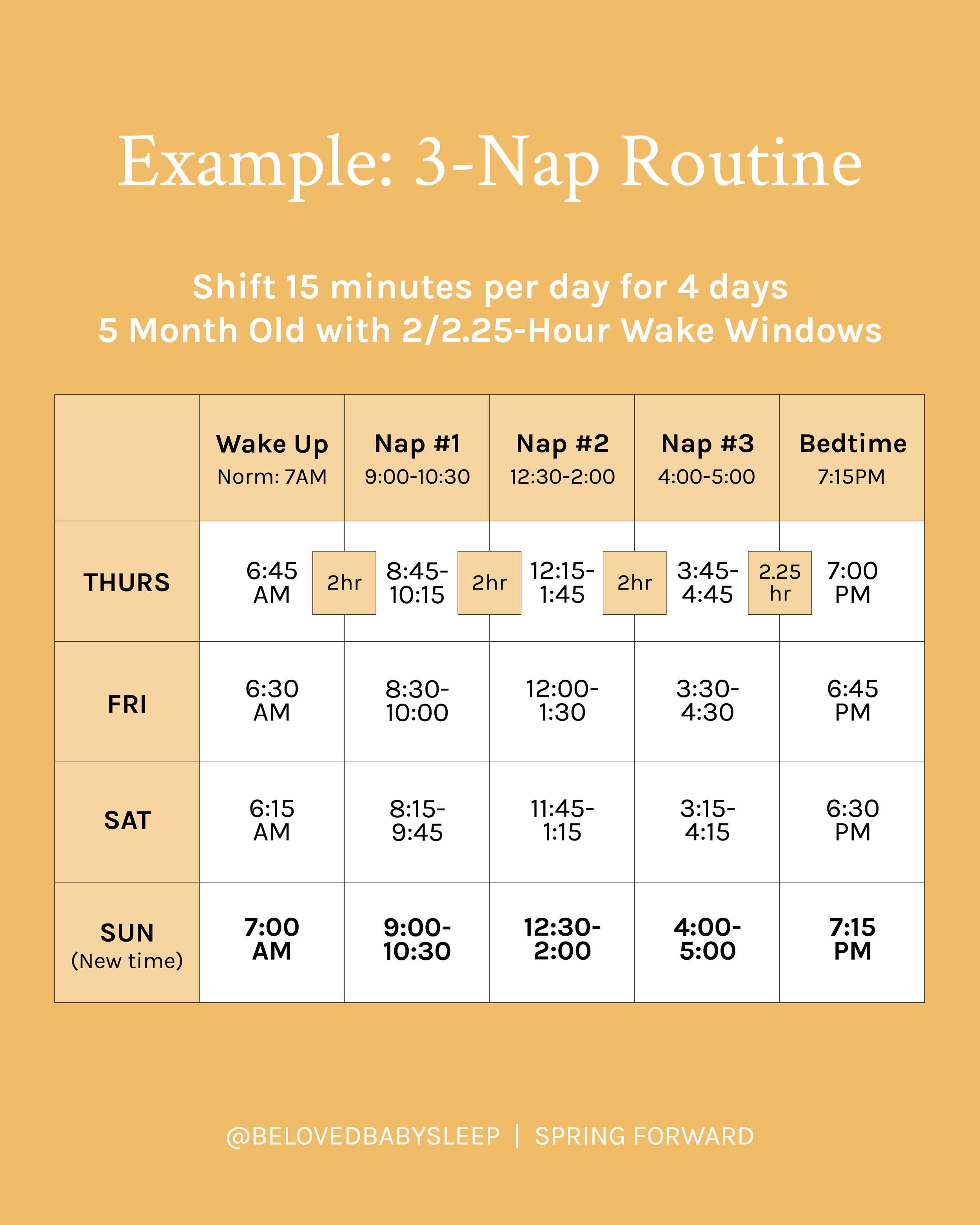
Shift your routine 15 minutes per day starting 4 days prior to the time change.
Shift your entire routine an hour later in the summer months.
Wake them based on the time on the clock and adjust in the days following.
1. Shift your routine 10 minutes per day.
Starting on the Tuesday BEFORE the time change on Sunday, you will get your child up 10 minutes earlier than normal, begin their nap(s) 10 minutes earlier than normal, and move bedtime 10 minutes earlier than normal. The next day, you’ll begin 20 minutes earlier than normal; the next, 30 minutes. By the time Sunday arrives, you will have shifted your entire routine by 60 minutes.
Here are some examples of this (click on each to zoom in).
Download a printable FREE 6-Day Daylight Savings Time Planner to track your child’s sleep during this adjustment.
2. Shift your routine 15 minutes per day.
Starting the Thursday BEFORE the time change on Sunday, you will get your child up 15 minutes earlier than normal, begin their nap(s) 15 minutes earlier than normal, and move bedtime 15 minutes earlier than normal. The next day, you’ll begin 30 minutes earlier than normal; the next, 45 minutes. The following day (Sunday), you have shifted your entire routine by 60 minutes.
Here are some examples of this (click on each to zoom in).
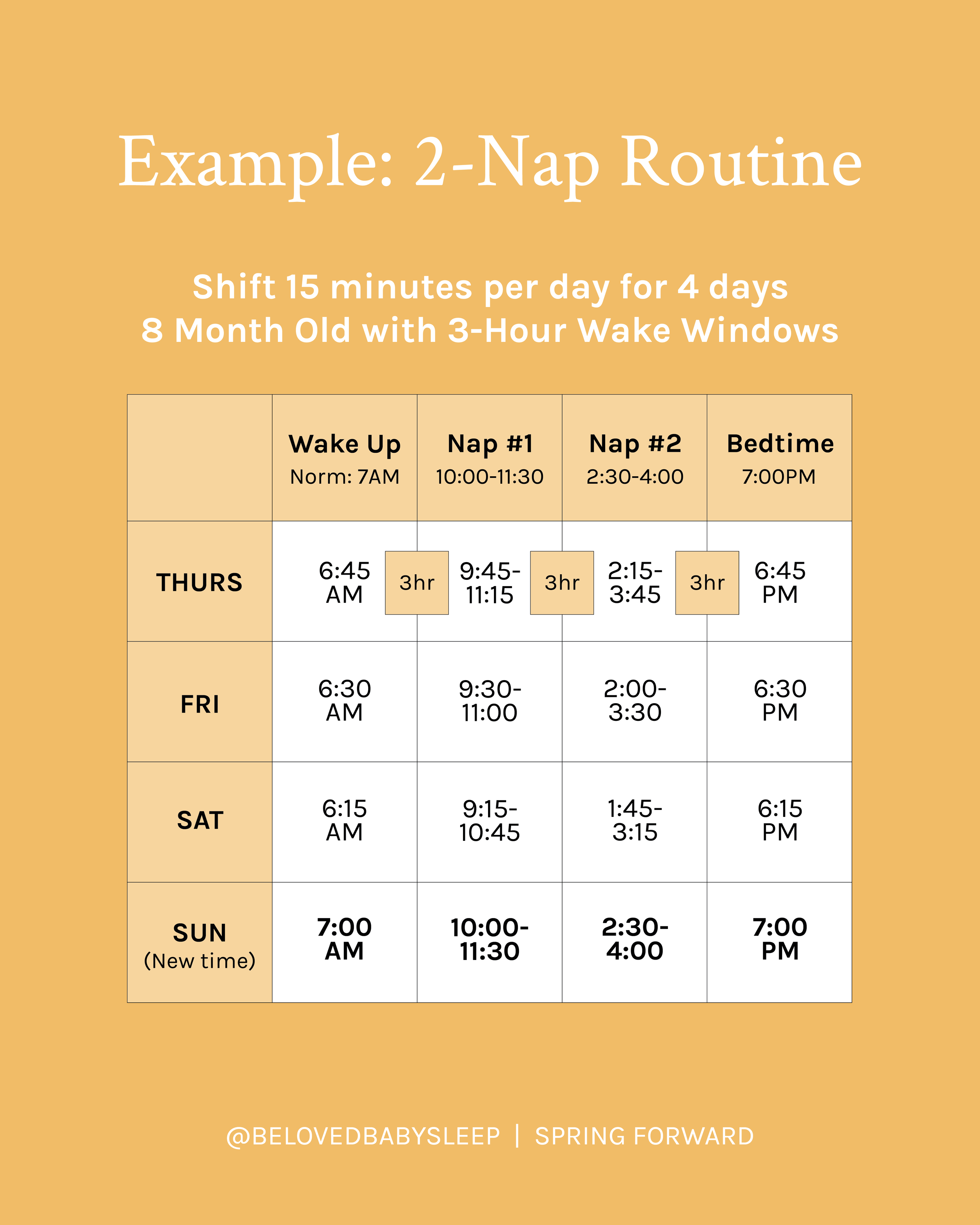
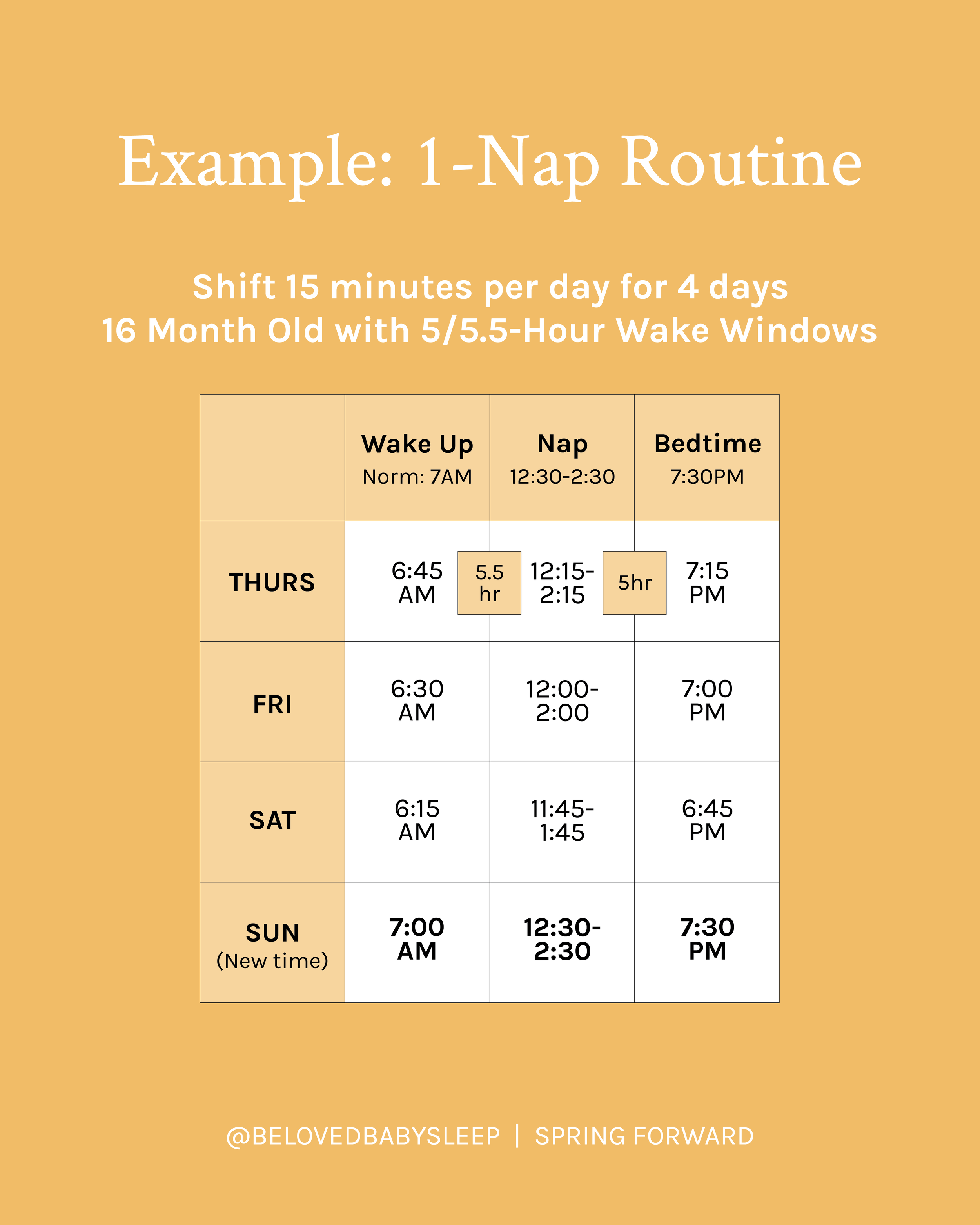
Download a printable FREE 4-Day Daylight Savings Time Planner to track your child’s sleep during this adjustment.
3. Your entire routine will shift an hour later in the summer months.
You can choose to simply move your child’s entire routine forward by an hour during the spring/summer months, and when Daylight Savings Time comes again in the fall (in the United States), the routine will shift again. Instead of your child getting up at 7am, they will get up at 8am. And instead of going to bed at 8pm, they will go to bed at 9pm. This works for some families (especially in the summer), and it’s a perfectly functional work-around.
4. Get your child up based on the time on the clock.
Instead of shifting your routine gradually or not changing anything at all, you will go by the clock only. You will get them out of their crib/bed based on the time on the clock (or within 15-20 minutes of their typical wake-up time). Through the day, you will offer their normal naps and bedtime based on the clock, or getting as close as possible to their norm.
In theory, after a few days or up to a week, their internal clocks will begin to adjust to the new normal, and they will wake closer to their typical time on the clock. For some children, this works beautifully (especially older toddlers and preschoolers who tend to be a bit more flexible when it comes to adjusting time awake). For others, this can be harder.
If your little one is having a hard time after the time change, we may need to help ease them into the new norm. We can apply a gradual shift (10-15 minutes) over the course of the week following, slowly shifting their routine earlier.
Is there anything else we can do to help with the adjustment?
Absolutely! I recommend plenty of outdoor time and play/activity the Sunday of the time change and the days following, as this helps reorient the body to the new normal. Light and darkness play a big role in setting our internal body clocks, and being outside in the light tells our brains when it’s time to be awake, and when it starts to get dark, our brains shift into wind-down mode. This is particularly helpful for children who struggle to make the shift after the time change.
As always, when it comes to sleep, it really helps to start with a foundation of healthy sleep habits. A child who is well-rested is far more likely to adjust to a shift than a child whose sleep is hit or miss. The best way to achieve this is to give children the gift of independent sleep. If this area is a struggle for your child, consider making a change either before or after the time change—take a look at my services to see what will fit your needs best, or schedule a free 15-minute call where I’ll help you pinpoint what you need. I am happy to help!
Please note that I am not a medical professional, and this blog post is not meant to serve as medical advice, a diagnosis, or any form of treatment. If you have any questions or concerns, please discuss them with your child’s pediatrician.